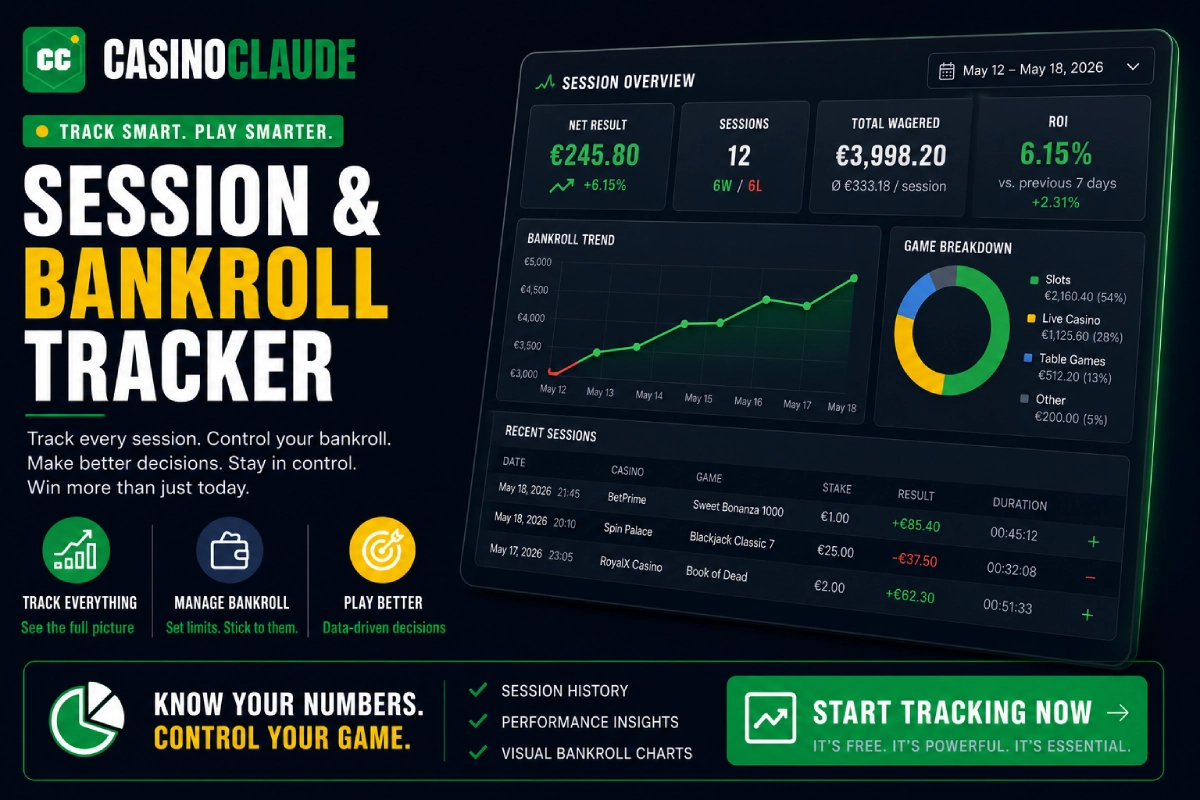
Most players think they know how they’re doing at the casino. They don’t. Memory is a story-teller: it inflates the wins that felt good and quietly forgets the sessions that ended flat. Ask a casual slots player how last month went and you’ll get a shrug and a “not bad.” Ask them for the P/L to the pound and you’ll get silence. The gap between those two answers is where problem gambling starts, and where a lot of otherwise-fine gambling budgets quietly leak. This tracker isn’t clever. It’s a table. But a table you actually fill in after every session will change what you think about the game more than any strategy guide.
Why tracking matters
Two things happen when you write down a session honestly. First, the average settles down to something realistic, usually a small loss, occasionally a small win. That number stops surprising you. Second, patterns start to appear. You’ll notice that your best sessions are the shortest, that anything over ninety minutes is almost always negative, that the games you thought were profitable are actually the ones eating your bankroll fastest. None of this is guesswork; it’s just data you didn’t previously have.
Everyone who tracks for more than a month tells us the same thing on player forums: they were misremembering the ratio of wins to losses, usually by a factor of two or three. The house edge doesn’t lie, but the brain absolutely does. A logbook is not a strategy, it’s an audit. Once the audit is honest, the strategy takes care of itself.
What patterns to look for
Once you have ten to fifteen sessions logged, look at the win rate (percentage of sessions in profit, not the lifetime P/L). Anywhere between 35% and 45% is normal for slots players; blackjack players using basic strategy will hover around 45-50%. If you’re above 50% and the total P/L is still negative, you’re winning small and losing big — the classic chase pattern. If you’re below 30% and the P/L is even, you’re winning big occasionally in ways you can’t reproduce — variance flatterer.
Look at average time played next. Shorter sessions almost always beat longer sessions from the same bankroll, because you’re not compounding the house edge across more spins. Then look at the notes column for repeat mistakes: chasing a specific slot, playing after alcohol, playing after a loss. Two months of notes will teach you more about yourself than any book on gambling.
How casual players fool themselves
Without a log, three things happen. Wins get promoted to memory as “the time I won three hundred.” Losses get demoted to “a bad night, I don’t play like that normally.” Break-evens get erased entirely. Ask a casual player how many break-even sessions they’ve had and they’ll say “a few.” A log will show it’s more like a third of everything.
The other trick is time. Players count deposits, not hours. Two hundred pounds down over six sessions feels different from two hundred pounds down over sixty sessions, but the outcome is identical. Tracking time forces honesty about how much of the month is actually being spent gambling, which for a lot of casual players is where the real budget problem lives. Cash is limited. Time isn’t.
The tracker
Log a session
Running totals
Last 10 sessions
| Date | Start | End | P/L | Time | Notes |
|---|---|---|---|---|---|
| No sessions logged yet. Add one above. | |||||
Session profiles compared
Below is the average shape of a slots player’s month, according to the session logs the review desk has kept across a hundred-plus test accounts. The “how it’s remembered” column is where casual players’ memories almost always land. The “how often it happens” column is what a log actually shows.
| Session type | Typical outcome | How it’s remembered | How often it happens |
|---|---|---|---|
| Fast win | +£40 in 20 min | “Best night in months” | Common, forgotten in a week |
| Break-even grind | ±£5 in 90 min | “Won a bit, lost a bit” | Roughly a third of sessions |
| Slow drain | −£60 in 2h | “Fine, I broke even” | The single most common outcome |
| Chase-loss night | −£150 in 4h | “One-off, rough night” | Once or twice a month |
| Variance blowup | +£800 in 15 min | “Every visit basically” | Once every 3–6 months |
If the totals surprise you
A month of honest logging and a P/L that shocks you is not a sign the log is wrong. It’s a sign the memory was. Set a monthly cap, walk earlier, or take a break — the tracker is doing exactly what it’s meant to do.