
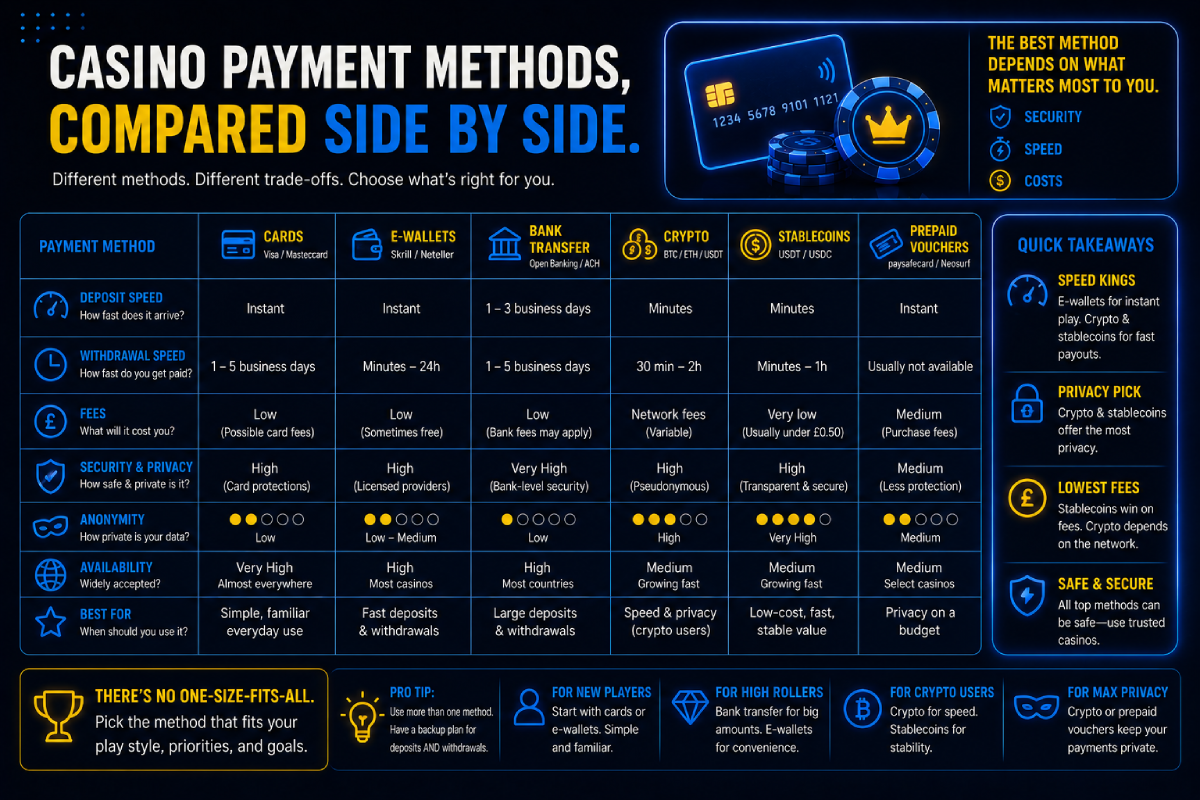
Every casino cashier in 2026 shows you the same neat row of logos, and every casino cashier makes the four methods behind those logos look interchangeable. They are not. The differences show up the moment something goes sideways: a delayed payout, a bonus you did not qualify for, a chargeback you cannot get, a stablecoin conversion that quietly ate two percent of your withdrawal. This piece runs the four dominant methods side by side on the things that actually decide a session: how fast the money moves, what the money costs, how the bonus rules treat it, and what recourse you have when the operator drags its feet.
Numbers below are the medians we have logged across our own eight-market test wallet over the past twelve months, not the marketing headlines. “Instant” is defined as “credited to the balance inside sixty seconds”, “same-day” as “in your account before you go to bed”, and so on. Your mileage will vary by operator, but the ranking between methods rarely does.
The side-by-side comparison table
| Method | Deposit speed | Withdrawal speed | Typical fees | Bonus eligible | Consumer recourse | Best for |
|---|---|---|---|---|---|---|
| Debit card | Instant | 1-3 business days | Rare on deposit; issuer FX only | Yes, almost always | Chargeback rights (limited on gambling) | Players who value simplicity |
| Credit card | Instant, where legal | 1-3 business days | Cash-advance fees at some issuers | Yes | Strong chargeback rights (but banned in UK, NL, IE for gambling) | Nothing worth the risk |
| E-wallet (Skrill, Neteller) | Instant | Same-day, often under 4 hours | 1-2% on deposit, 0-2% on withdrawal | Frequently excluded from welcome bonuses | Wallet dispute process, weaker than card | Fast payouts if you skip bonuses |
| Revolut | Instant | Same-day | None at most operators | Yes, at most operators | Sits between card and wallet | UK/EU players wanting middle ground |
| Pay-by-bank / Trustly | Instant | Under 15 minutes typical | None to the player | Yes, at every operator we test | Bank-level protections, plus SCA | Most Europeans in 2026 |
| Crypto (BTC / ETH) | 1-30 minutes (network dependent) | Minutes once approved | Network fees only | Varies wildly by operator | Effectively none once sent | Players who already hold crypto |
| Crypto (USDT / USDC) | Minutes | Minutes once approved | Network fees, plus cashier spread | Varies | Effectively none once sent | Regulars at crypto-first casinos |
Debit and credit cards
Cards are the deposit method every casino accepts and the one operators quietly wish you would stop using. Deposits are effectively instant thanks to the acquiring rail; withdrawals are the slow half of the story because Visa Direct and Mastercard Send settle inconsistently across issuers. On paper the network says “up to 30 minutes”. In practice, one to three business days is the honest median across our test wallet.
Credit cards for gambling are outright banned in the UK, the Netherlands and Ireland, and blocked by most issuers even where they remain legal. Where they still work (parts of the US, some CA provinces, a handful of Asian markets), they carry cash-advance fees that make them a poor economic choice regardless of what the terms allow. Chargeback rights on gambling losses exist in principle and rarely land in the player’s favour in practice; issuers usually side with the operator once the transaction is authenticated.
E-wallets (Skrill, Neteller, Revolut)
Skrill and Neteller remain the most widely accepted e-wallets in gambling, both owned by Paysafe, both fast, both charging small deposit and withdrawal fees at most operators. Withdrawals settle in under four hours as a median, and often inside one, which is what keeps them in the top three methods for anyone chasing quick payouts.
The trap sits in the bonus terms rather than the fees. A large majority of European operators, including almost all of the UK big four, exclude Skrill and Neteller deposits from the welcome offer entirely. If a bonus is the reason you are picking a casino, e-wallet deposits will silently disqualify you and support will not warn you in advance. Revolut occupies a middle position: cheaper, usually bonus-eligible, but only accepted at a subset of operators and only useful if your bank supports it in your country.
Pay-by-bank and Trustly
If there is a winner in the 2026 payments race, this is it. Pay-by-bank, either via Trustly, Klarna Kosma or your bank’s own Open Banking rails, moves money directly between your bank account and the casino with no card number, no CVV and no middleman hoarding your data. Deposits credit inside sixty seconds. Withdrawals routinely settle inside fifteen minutes at operators that support outgoing payouts on the same rail, which is now the majority in the UK, Sweden, Denmark, Netherlands and Ireland.
The downsides are narrow. Not every smaller bank supports the standard yet, though the gap has closed sharply this year. A handful of operators still allow pay-by-bank one direction only, deposits in, cards out, and every one of those operators loses points on our review desk because it is a friction choice, not a compliance one.
Crypto (BTC, ETH, stablecoins)
Crypto is the most improved payment method in the licensed-operator space this year. More sites accept it, cashier flows have finally stopped requiring hand-copied wallet addresses, and payout speed is competitive with pay-by-bank at the operators that have built the tooling properly. Fees are down to network gas costs at most crypto-first casinos.
The catches split cleanly. Bitcoin and Ethereum are volatile, and if the price moves five percent between deposit and withdrawal, your session P&L is a mixture of gambling result and coin price, which few players find useful. Stablecoins fix that in principle (USDT and USDC target the dollar), but stablecoin cashiers frequently apply a spread on conversion that is not listed in the fees section, quietly worth one to two percent per direction. Crypto rewards players who already hold and understand the assets. For anyone buying coin for the first time to use at a casino, the friction and the hidden costs almost always outweigh the speed.
Which one to pick, by scenario
- Fastest payout, minimum friction: pay-by-bank, at any operator that supports it in both directions.
- Claiming a welcome bonus: debit card or pay-by-bank. Skip e-wallets unless the terms explicitly allow them.
- Maximum privacy: a well-secured e-wallet or, if you already hold coin, a stablecoin transaction from a self-custody wallet.
- Cross-border play (travelling, expat, dual-country): Revolut for legal, licensed sites; a self-custody stablecoin wallet for crypto-first sites.
- The player who values recourse over speed: debit card. Slower payouts, but the strongest dispute path if something breaks.
How this fits our reviews
Every number in this guide is a median from our own deposits and withdrawals across the eight markets we cover. When we call an operator “fast” or “slow” in the market pages, this is the baseline we are comparing them to. Pick a country from the top menu to see the ranking applied to specific sites.
FAQ
Which method has the fastest withdrawals?
Pay-by-bank at every operator that supports it in both directions. Crypto is comparable at crypto-first casinos, with the caveat of network-confirmation windows for Bitcoin and Ethereum. Cards are consistently the slowest, regardless of what the deposit-side marketing suggests.
Are e-wallets safer than cards?
They add a layer of separation between your primary bank account and the casino, which matters for privacy and for containing the blast radius if the operator’s systems are compromised. On a well-secured debit card at a licensed casino, actual fraud risk is comparable. The bigger safety difference is dispute-resolution: card networks have stronger tooling than most wallet providers.
Can I mix methods, deposit with one and withdraw with another?
Sometimes, and sometimes not. Under AML rules, most licensed casinos require your first withdrawal to return to the deposit source up to the amount deposited. Anything above that can usually go to a different method. Always read the cashier’s own terms before you deposit; getting the sequence wrong turns a two-hour payout into a two-week one.
Do stablecoin cashiers ever charge a hidden spread?
Yes, and this is the single most under-discussed cost in casino payments. Most stablecoin cashiers show USDT and USDC as “$1” but internally apply a bid-ask spread of one to two percent on each conversion. Two directions of that spread quietly costs a regular player more than the wagering weighting on a slot bonus.