
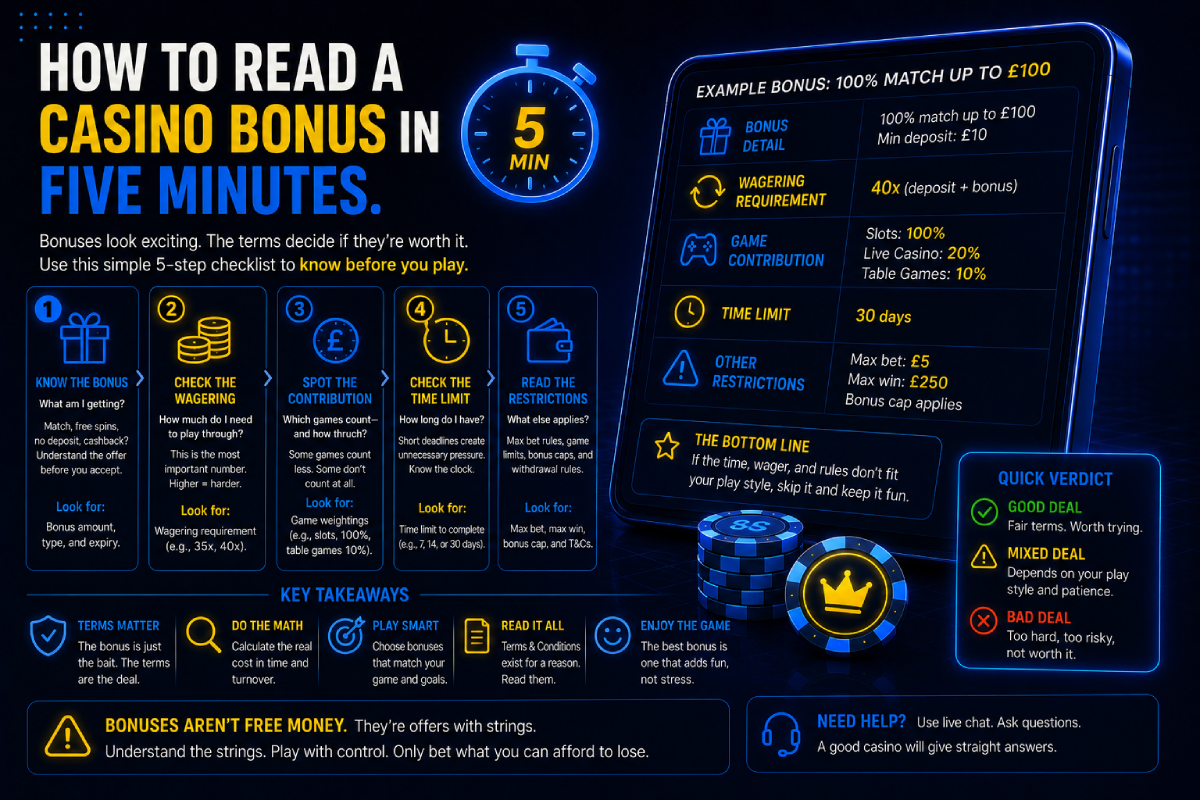
A well-chosen casino bonus is a genuine head start. A badly chosen one is a balance you watch idly for a fortnight before it evaporates. In both cases the outcome was decided the moment you accepted the promotion, and in both cases the deciding evidence sat in the same four lines of the terms and conditions page. This guide walks you through how to find those lines, read them out loud in plain English, and reach a verdict before you tick the “I accept” box.
None of this needs a calculator. Once you have seen the four lines a dozen times, you can spot a bad offer inside a minute and dismiss it before your card details are anywhere near the cashier. The four lines are the same at almost every licensed operator in 2026, from the biggest UK brands down to the smallest crypto-first sites, which is what makes the checklist portable.
Line one: the wagering requirement
Wagering is the multiplier that decides how much you must stake before the bonus stops being play-money and turns into cash you can withdraw. Read the number, then read the two words next to it, because that is where the offer really lives. “35x bonus” on a £100 bonus means £3,500 in total bets before the balance is yours. “35x deposit + bonus” on a matched £100 + £100 promotion means £7,000, exactly double the work for the same headline number. The multiplier by itself tells you nothing; the multiplier plus its target tells you everything.
As a rough scale for 2026, anything at or below 30x on the bonus alone is generous, 35x is the market average, and 45x or higher starts to eat into whether the offer is worth claiming at all. Once you add “deposit + bonus” into the sentence, halve every one of those numbers to keep the comparison fair.
Line two: the maximum bet cap
The moment a bonus is active, most casinos cap the size of any single wager. A £5 cap is normal, £4 shows up at British and Swedish operators, and £2 has been creeping back in at the tougher-terms end of the market. Break the cap even once, even by accident, even by tapping the wrong chip on live roulette, and the balance can be voided with everything you have won on top of it.
The reasoning behind the cap is not vindictive, it is defensive. The casino does not want a player clearing a 35x wagering requirement with three high-stake blackjack hands and then walking with the difference between win and loss. If the cap seems mean, remember that it is the price of the bonus existing at all.
Line three: game contribution
Every casino runs a “game contribution” or “weighting” schedule that says how much each pound wagered on a given game type counts towards the wagering requirement. Slots almost always contribute 100%, meaning one pound bet is one pound cleared. Live tables usually contribute 10% to 20%. Some jackpot slots and some VIP tables contribute zero, which effectively removes them from the promotion.
This line changes the real cost of an offer more than any other, and it is the one that slips past new players most often. Two bonuses with an identical 35x headline can be different promotions entirely once weighting is applied. The table below shows the maths on a £100 bonus with a 35x requirement, and it is worth internalising because you will do this calculation over and over.
| Game type | Typical contribution | Effective wagering on a 35x bonus | Bets needed on £100 bonus |
|---|---|---|---|
| Slots | 100% | 35x | £3,500 |
| Roulette | 20-50% | 70-175x | £7,000-£17,500 |
| Live blackjack | 10% | 350x | £35,000 (effectively ineligible) |
| Video poker | 10-20% | 175-350x | £17,500-£35,000 |
| Jackpot slots | 0-50% | Often excluded | Not counted |
Line four: time to complete
Wagering deadlines usually sit in three brackets: seven days, fourteen days, or thirty. The headline number and the game contribution are only half the story; the deadline is what decides whether the maths are physically achievable at your normal budget. A 35x bonus with thirty days to run is a very different animal to a 35x bonus with seven, especially if you usually only play two or three evenings a week.
A quick sanity check: divide the total bets required (headline requirement multiplied by 100/contribution) by the number of days on the clock, then by your normal average stake. If the answer is a number of spins or hands you would happily play anyway, the offer fits your habits. If it is triple your normal volume, you are looking at a bonus designed to stay unfinished.
The four T&C lines that matter, at a glance
| Line | Where to find it | Fair in 2026 | Walk-away signal |
|---|---|---|---|
| Wagering requirement | Top of the bonus terms | 30-40x on bonus, or 20-25x on deposit + bonus | 60x+ on deposit + bonus |
| Maximum bet cap | Usually paragraph two or three | £4-£5 per spin/hand | No cap listed (rules can be applied retroactively) |
| Game contribution | Separate weighting table, often linked | Slots 100%, tables 10-20% | Slots capped below 100%, or all games at 5-10% |
| Expiry / time to complete | Near the bottom of the T&Cs | 14-30 days | 72 hours to 7 days on a triple-figure bonus |
Putting it together into a verdict
Once the four lines are lined up, the “is this actually a good offer” question collapses into something almost mechanical. Take the wagering requirement, adjust it for the game contribution of whatever you will actually be playing, divide the total by your normal stake to get a bet count, and check that the bet count fits inside the expiry window at a pace you find enjoyable. If the answer is yes, the offer earns its place in your session. If the answer is no, the offer is designed for balance, not for payout, and you should walk.
The habit worth building is smaller than it sounds. The best bonus is the one attached to a deposit you would have made anyway, on a game you would have played anyway, at a stake you would have used anyway. Anything that pushes you outside those three habits, higher stakes, unfamiliar games, longer sessions than you had planned, is the offer working on you rather than for you.
How this fits our reviews
Everything on this page is the same checklist we run on operators before they appear in our market rankings. When we call an offer “fair” or “player-hostile” on the UK, Sweden or Netherlands pages, this is the workout behind the verdict. If you want to see the method applied to specific sites, pick a country from the top menu.
FAQ
Are “no wagering” bonuses too good to be true?
Not usually, but the trade-off is size. A no-wagering offer is genuine cash the moment you win with it, so operators keep the numbers small and often cap the maximum you can withdraw from the promotion. Ten pounds no-wagering and one hundred pounds with 35x are, on average, worth about the same to the player over enough sessions.
What’s a fair wagering requirement in 2026?
Thirty to forty times the bonus alone is the current market average. Thirty times or under on deposit + bonus is generous. Anything above fifty times on deposit + bonus is a bonus designed to remain on your balance, not one designed to pay out.
If I break the max bet cap by accident, is there any recourse?
Rarely. Most licensed operators will void the bonus balance and any winnings on top of it without a discussion, and the terms usually give them the right to do so. Some will honour a good-faith refund if you contact support inside the hour, but that call is entirely at their discretion and never guaranteed.
Does the same checklist work for free-spin offers?
Yes, with one extra line. Free spins usually create a bonus balance from any winnings, and that balance carries its own wagering, contribution and expiry. Read the four lines exactly as you would for a match bonus, and check whether the spins themselves have a bet-size restriction (10p or 20p is normal).